Finding hotels with accessible rooms can be surprisingly frustrating. Listings often use vague labels like “accessible room” or “disabled access” without explaining whether that means a roll-in shower, grab bars, or simply a room on the ground floor. You book with confidence, arrive with a wheelchair or limited mobility, and discover the reality doesn’t match the description.
This guide walks you through the whole process, step by step. We’ll cover why extra research is needed before you book, the specific features to verify, the questions worth asking the hotel directly, and how to time your booking so the right room is actually available. We’ll also look at which destinations and hotel types tend to work best for accessible travel, the red flags to watch out for, and a short wrap-up to pull it all together. A little preparation makes a big difference.
Why Booking Hotels with Accessible Rooms Requires Extra Research
If you’ve ever tried to book an accessible room and found “no availability” while standard rooms are still open, there’s a simple explanation: accessible rooms are typically only 5-10% of a hotel’s total inventory. That small pool sells out first, often weeks before the rest of the hotel fills up. Travelers who wait until the last minute frequently find that the only option left is a room that doesn’t meet their needs at all.
Vague labels are part of the problem
Even when an accessible room is available, the description on the hotel’s own website often raises more questions than it answers. Many sites label a room “accessible” without saying whether it has grab bars, a roll-in shower, or doorways wide enough for a wheelchair. Two rooms in the same hotel can carry the same label while offering completely different levels of access, so the label alone tells you very little.
Third-party booking sites make this harder, not easier. Their filters usually stop at “accessible room” as a yes-or-no checkbox, and the detailed features — shower type, doorway widths, bathroom layout — rarely appear in the listing at all. That’s why direct contact with the hotel is usually necessary. A quick call or email to the front desk gets you specifics that no booking platform will provide, and it also puts a name to your request, which helps when it’s time to confirm your reservation.
Key Features to Verify Before You Book
Before you pay anything, get concrete measurements and features confirmed rather than accepting a generic “accessible” label. The details that matter most are the ones you can’t see in photos: how wide the doorways actually are, how much space there is to turn a wheelchair in the bathroom, and what kind of shower the room has. Ask the hotel to check the specific room, not just the room category, since features can vary between rooms of the same type.
Start with the basics. Doorway widths of at least 80-90 cm are needed for most wheelchairs, and a standard accessible bathroom needs a turning circle of about 1.5 m. If the person booking uses a larger power chair or mobility scooter, ask the hotel to measure and confirm in writing. Then move on to the bathroom itself and the rest of the property.
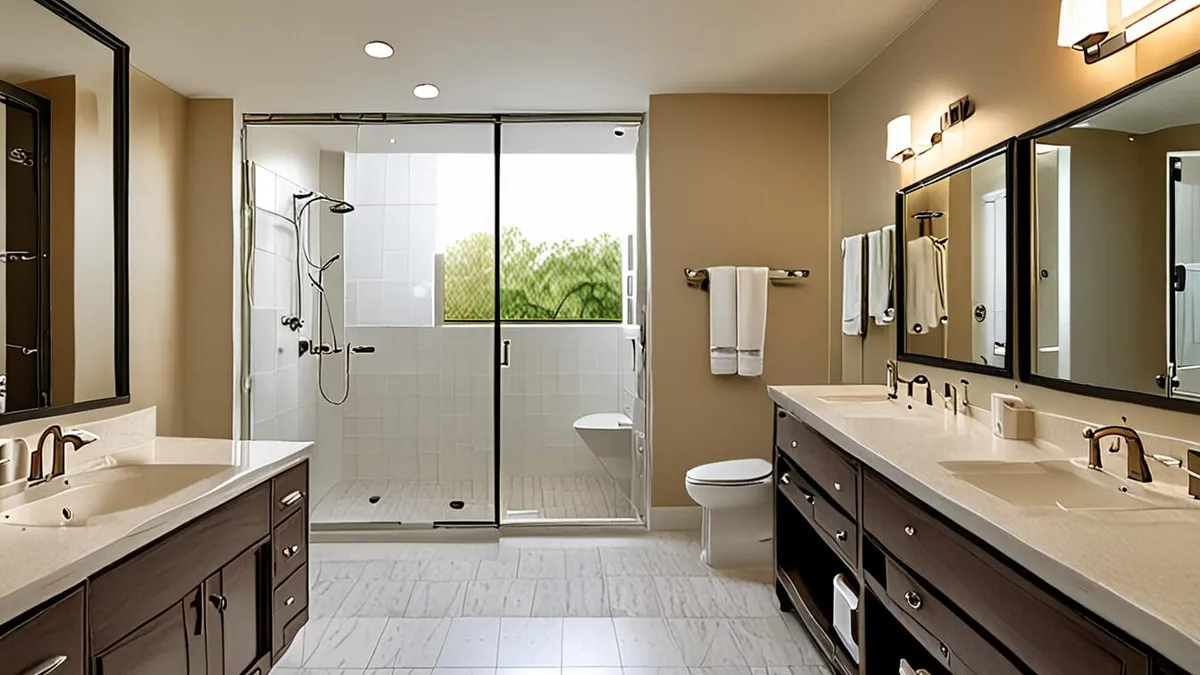
- Roll-in shower, not just an “accessible bathroom.” Roll-in showers are the most requested bathroom feature, and the one most often substituted. Ask specifically whether the shower is level-entry, and confirm grab bars and a shower seat are installed — some “accessible” bathrooms only offer a tub with a rail.
- Elevator access to the room’s floor. A room may be listed as accessible yet sit on a floor reachable only by stairs, or the elevator may be too small for some mobility devices. Confirm the elevator reaches your floor and fits your chair.
- Step-free public areas. An accessible room loses much of its value if the restaurant, pool, or lobby can only be reached via steps. Ask whether these areas have ramps, level entrances, or step-free routes from the elevator.
Getting these three areas confirmed before booking saves you from the most common disappointments — and gives you something in writing if anything goes wrong on arrival.
Questions to Ask the Hotel Directly
Once you’ve found a hotel that looks promising, a short, specific set of questions will tell you far more than any listing page ever could. Front desk staff are usually happy to check details for you, but only if you ask precisely. Vague questions get vague answers, so keep your requests concrete and write down what you’re told, including the name of the person who answered. Speaking with someone who has actually seen the accessible rooms, rather than someone reading from a screen, tends to give the most reliable information.
- Ask about the shower type. Find out whether the accessible bathroom has a roll-in shower or only a tub with grab bars. These are very different rooms for a wheelchair user, and hotels sometimes use the same “accessible” label for both.
- Request written confirmation of a specific room number and floor. A room type can be swapped or re-allocated without notice; a specific room number and floor is much harder to change. Ask the hotel to confirm the exact room by email so your request is attached to the reservation itself.
- Ask about parking, the entrance, and luggage help. Find out how far the accessible parking spaces are from the entrance, whether there are steps at any entrance, and whether staff can assist with luggage. These details shape your arrival experience more than almost anything else.
Send these questions by email whenever possible, so you have the answers in writing. If you call first, follow up with a short email summarizing what was promised and ask the hotel to confirm it. That record protects you if the room you’re given on arrival doesn’t match what you were told, and it gives the front desk something concrete to check against when they prepare your room.
It also helps to time your questions sensibly. Calling during a quiet period, such as mid-morning on a weekday, usually gets you a more patient and thorough answer than calling during check-in rush. If the first person you speak to seems unsure, politely ask whether someone else, such as a housekeeping supervisor or duty manager, can verify the details. Small hotels may need to check in person before answering, and that hesitation is often a good sign that they’re taking your request seriously rather than guessing.
When and How to Book for the Best Availability
Timing matters more for accessible rooms than for any other type of booking. Because these rooms are limited in number, they tend to be reserved well before the standard rooms are gone. For regular travel, aim to book 2-3 months ahead. If you are traveling in peak season between June and August, push that window out to 4-6 months in advance. The earlier you lock in a room, the more likely you are to get one that actually meets your needs rather than settling for whatever is left.
Why booking direct gives you an advantage
When you reserve through a third-party site, your special requests travel through a middleman and can easily get lost or treated as optional. Booking directly with the hotel means your accessibility requirements are attached to your actual reservation, where the front desk and housekeeping team can see them. It also gives you a named contact to follow up with if anything changes before your arrival.
Before you pay any deposit, ask the hotel to confirm every promised feature by email. That means the roll-in shower, the doorway widths, the floor and elevator access, and the specific room itself. A written confirmation protects you if you arrive to find a different room type assigned, and it gives the hotel a clear record of what they committed to. Most hotels are happy to send this; if one hesitates, treat that as useful information about how they handle accessibility overall.
Choosing Destinations and Hotel Types That Suit Accessible Travel
Where you go shapes how easy your trip will be, sometimes more than which hotel you pick. Flat, compact city centers with reliable public transport are generally much easier to manage than hilly or spread-out destinations, where every outing becomes a logistics exercise. Before falling in love with a location, think about the distance between your hotel and the sights, and whether the streets themselves are navigable.
Hotel type matters too. Larger hotels and international chains tend to offer standardized accessible rooms more consistently than small guesthouses, because they build to uniform brand standards and usually have several accessible rooms rather than one. A small family-run guesthouse may be welcoming and flexible, but it may also occupy a converted building with no elevator at all.
Historic old-town districts deserve special scrutiny. They are often the most atmospheric part of a city, but they frequently come with steps at entrances, narrow doorways, and cobbled or sloped streets. If an old town is on your list, such as when browsing hotels near Edinburgh’s historic old town, verify street-level access carefully rather than assuming a central hotel is automatically convenient.
- Check whether the hotel’s main entrance is step-free or has a portable ramp, since some older buildings keep a permanent ramp at a side or rear entrance instead.
- Look at the neighborhood around the hotel, not just the building itself, because a step-free hotel on a steep hill can still be exhausting to leave each day.
- Ask whether the hotel’s restaurant, bar, and other public areas are on the same level as the lobby, since some properties place dining areas up a short flight of stairs.
Red Flags and Common Mistakes to Avoid
Some booking mistakes are easy to make and costly to discover on arrival. The most common one is treating a “ground floor” label as proof of accessibility. A room on the ground floor may still have a bathroom with a tub, a high bed frame, or a doorway too narrow for a wheelchair. Ground floor tells you where the room is, not what is inside it.
Photos are another trap. A wide-angle lens can make a modest room look spacious, and no photo shows you whether the shower is step-free or how high the bed sits off the floor. Use photos as a starting point, then confirm the details with the hotel directly. A few specific questions will tell you far more than any gallery of images.
The biggest mistake of all is waiting until you arrive to explain your needs. By then, rooms have been allocated and the hotel may simply have nothing suitable available, even if staff want to help. Requests raised at check-in are often met with apologies instead of solutions.
- Watch out for vague phrases like “disabled-friendly” or “wheelchair accessible” in descriptions that never mention a specific feature, since these labels can mean almost anything.
- Be cautious if a hotel says an accessible room exists but cannot confirm one is available for your dates, because “we have one somewhere” is not the same as a reserved room.
- Take note of hotels that cannot put accessibility details in writing, since reluctance to confirm by email often signals uncertainty about what the room actually contains.
One more pitfall is assuming that a room type, once reserved, guarantees the features you need. A category name like “superior accessible” can still cover several different rooms with different layouts. Ask the hotel to note your requirements on the reservation itself, and keep the reply on file. If anything is missing when you check in, that written record makes it far easier to ask for a correction on the spot rather than settling for whatever room is left.
Wrapping Up Your Accessible Hotel Search
Finding a genuinely accessible hotel room comes down to one habit: verifying the details yourself instead of trusting a listing label. Ask the hotel directly, get the specific features confirmed by email before you pay, and book early, because accessible rooms are limited and tend to go first.
Just as important is choosing destinations and hotel types where step-free access is realistic for your needs, so the room itself is not the only hurdle. If you have found this guide useful, or you have your own tips for checking accessibility before booking, leave a comment below or share the article with a fellow traveler.