You’ve booked the lodge, packed the bags and then checked the forecast: wall-to-wall rain. Suddenly you’re wondering whether a wet day means a wasted day, and whether you should have picked somewhere sunnier instead. It’s a common moment of doubt, and it’s exactly what this guide is here to fix.
Lodge holidays in the rain can be genuinely enjoyable, not just survivable. A well-chosen lodge turns a downpour into a backdrop rather than a problem, with hot tubs, wood burners and big windows doing most of the work. Below you’ll find why wet lodge trips often work better than hotel stays, how to pick a lodge built for rainy days, what to pack, how to fill a full indoor day, how to use short breaks in the weather, and which destinations suit drizzle best. By the end, rain will feel like part of the plan rather than a threat to it.
Why Lodge Holidays in the Rain Work So Well
A lodge is a self-contained base, and that changes everything about a wet day. You have a kitchen, a living room and often a veranda or hot tub on site, so rain costs you nothing. Compare that with a hotel stay, where a rainy day can mean paying for meals out, day trips and activities just to fill the hours. At a lodge, the day’s entertainment is already under your roof.
Wet months, lower prices
The wettest months in most European lodge regions fall between October and January, which happens to be low season. Rainy-season lodge rates often drop 20-40% versus peak summer weeks, so you can get a bigger deck, a better view or a hot tub for the budget that would only buy a basic cabin in July. Check current prices with operators, but the seasonal pattern is consistent enough to plan around.
The scenery improves
There’s also the photography argument. Forests, fjords and mountains look their most dramatic in mist and drizzle, with layered ridgelines, low clouds and saturated greens that bright sunshine flattens out. If you shoot landscapes, a rainy lodge trip gives you conditions most summer visitors never see. Pack a lens cloth, keep your camera dry, and let the weather do the artistic work.
Not every lodge copes well with a week of drizzle, so the booking stage matters more than you might think. Rather than browsing endlessly, use filters and keywords when you search: covered veranda, hot tub, sauna and wood burner are the four features that turn a rainy day from an inconvenience into a highlight. Many booking sites let you filter by these amenities directly, so start there before you fall in love with a photo.
Look at the living space, not just the bedrooms
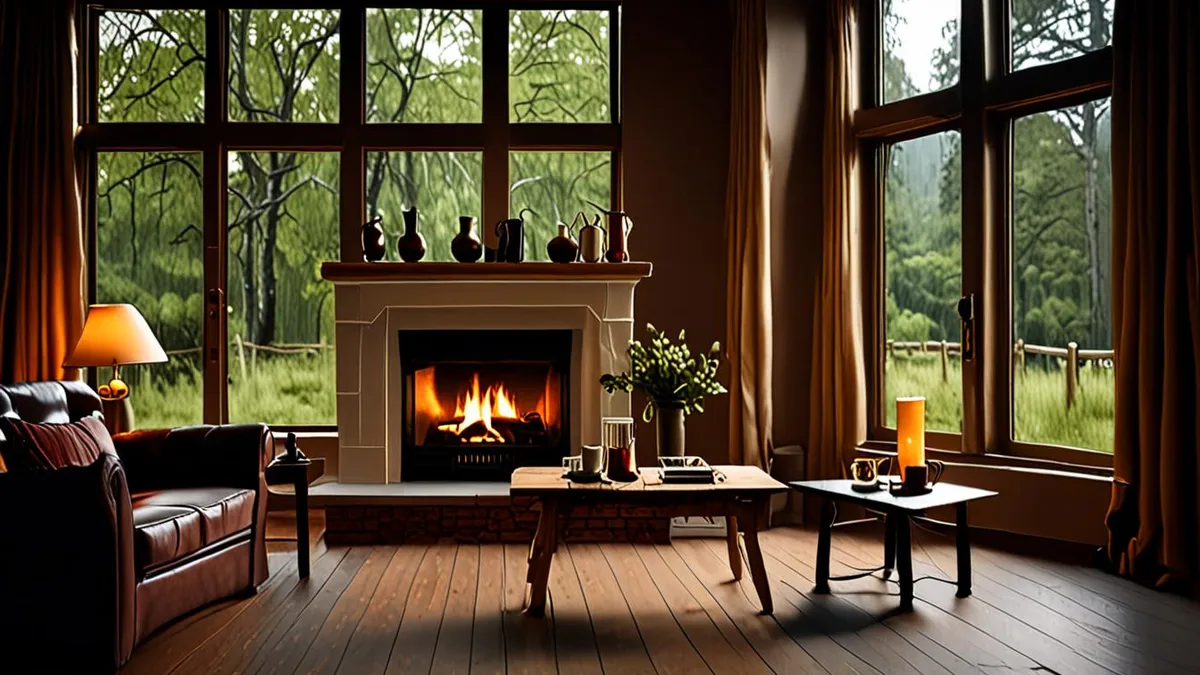
Photos of lodges usually show the exterior or the hot tub, but what you’ll actually use on a wet day is the interior. Prioritize large windows and open-plan living space so you can enjoy the view from indoors instead of feeling shut in. A lodge with floor-to-ceiling glass facing the water or the hills will make a rainy afternoon feel like cinema, while a small, dark cabin with one window will make it feel like a wait.
- Covered verandas: check the photos for a roof over the deck, not just an open terrace, so you can sit outside with a coffee during light drizzle and keep the furniture dry.
- Saunas: a sauna turns a cold, wet walk into a proper routine, and it gives the evening a shape that a plain living room doesn’t.
- Wood burners: ask whether firewood is included or costs extra, because a burner you can’t fuel is just a decorative black box.
- Heated floors or drying space: some lodges add boot dryers or heated bathroom floors, which matter far more than you’d expect after three days of rain.
Book lodges with hot tubs or saunas 2-3 months ahead for autumn and winter stays. These features are limited even within popular areas, and the best-located lodges with covered outdoor space tend to be the first to fill for October to January dates.
Choosing a Lodge Built for Wet Days
Not all lodges handle a wet day equally well, so it pays to be picky before you book. The difference between a rainy weekend that feels restful and one that feels cramped often comes down to the design of the lodge itself. A covered veranda lets you sit outside with a coffee while drizzle falls a meter away, and a hot tub or sauna turns a gray afternoon into the highlight of the trip.
Look closely at the photos and floor plan, too. Large picture windows and an open-plan living space mean you can watch weather roll over a valley, loch or treeline without leaving the sofa. A lodge with small windows and a narrow lounge can feel like a waiting room once the rain sets in for hours.
Availability is the catch. Lodges with hot tubs, saunas or wood burners are the first to sell out once autumn approaches, so book 2-3 months ahead for stays in the wetter months. If you are booking late, use filters and search terms like “hot tub,” “log burner” or “covered terrace” to narrow listings quickly, and read recent reviews for mentions of how the lodge feels in bad weather.
- Check the heating source. A wood burner gives both warmth and atmosphere, but confirm whether logs are provided or cost extra locally.
- Ask about towel drying. A heated towel rail or drying cupboard matters more than you’d think when boots and jackets come in soaked.
- Confirm the hot tub is private. Some lodges share a spa area, which changes the experience on a rainy evening.
- Look at the window orientation. A big window facing a hillside or water beats one facing a car park, whatever the weather.
Packing for a Rainy Lodge Trip
Packing for a rainy lodge trip is really two packing jobs: kit that keeps you comfortable outside in short bursts, and kit that makes long hours inside genuinely pleasant. Get both right and the weather stops mattering. Get the outdoor half wrong and every dash to the car or viewpoint leaves you damp for hours.
The outdoor half
Bring a waterproof jacket rated 10,000mm+ rather than a fashion raincoat, and pair it with waterproof boots that have already been worn in. Add quick-dry layers, ideally synthetic or merino rather than cotton, because cotton holds water and cold against your skin all day. A small dry bag for your phone and a brimmed hat (umbrellas are hopeless in wind) round out the essentials.
The indoor half
The dry indoor kit is what separates a cozy wet day from a restless one. Slippers immediately make a lodge feel like home, and a power bank matters more than usual because lodges in remote spots can have temperamental sockets or Wi-Fi.
- Books and downloaded films: download everything before you travel, since rural lodges often have slow or metered Wi-Fi and streaming a film on a rainy night may simply not work.
- A towel bag: pack a separate cheap towel plus a plastic bag, so wet jackets, boots and swimsuits have somewhere to live without soaking the lodge’s own linens.
- Spare socks, plural: bring more pairs than you think you need, because nothing ends a wet walk’s good mood faster than pulling damp socks back on for the evening.
- A small daypack cover or liner: a simple rain cover keeps snacks, maps and spare layers dry on the short walks you’ll still want to take between showers.
With both halves covered, a soaked morning walk becomes a hot shower and dry socks rather than a ruined day, and the evening has books, films and hot drinks waiting.
Indoor Activities for a Full Wet Day
A fully wet day at a lodge is not a wasted day if you treat it as the main event rather than a gap to fill. The trick is to have a loose structure: something for the morning, a project for the middle of the day, and enough variety in the afternoon that nobody starts staring at the walls. Think of it like planning a good dinner party rather than filling time — a few anchors in the day, spaced out, so the hours feel deliberate instead of improvised. The families who enjoy rainy lodge trips most are usually the ones who decide the night before how the wet day will run, rather than waiting until mid-morning when everyone is already restless. Here is how to sequence it.
- Start with a slow morning. Make hot drinks first thing and eat breakfast at the table with the best window view. Bring out a board game or a deck of cards while the coffee is still warm, and resist the urge to check the weather every ten minutes.
- Launch a long cooking project. A lodge kitchen is a genuine kitchen, so use it. A slow-cooked stew, a loaf of fresh bread or a batch of soup turns hours of rain into hours of anticipation, and it fills the lodge with a smell that makes everyone glad to be inside.
- Rotate activities through the afternoon. Move between board games, downloaded films and reading nooks rather than settling into one. A change of seat, snack or activity every hour or so keeps the day fresh.
- Build in a proper break. Nap, journal, or simply watch the rain move across the valley. The slow pace is the point of the trip.
Planned this way, games, streaming and reading nooks comfortably cover four to six indoor hours per day without anyone feeling bored — and that is before you count meals, cooking and the long breakfast itself. The rotation matters more than the activities: the same film feels different watched from the sofa, the window seat or the corner armchair, and switching every hour or so resets everyone’s attention. Keep snacks and drinks within reach so nobody has to interrupt a game to forage, and let younger kids claim one drawer or shelf as their own rainy-day station. If a shower does clear, you already know from the radar that mountain rain often passes in under 60 minutes, so a short walk can slot in without derailing the plan. By the time the light fades, the stew is ready and the day feels full rather than lost.
Making the Most of Breaks in the Weather
Some destinations do not just tolerate rain, they improve because of it. If you are choosing a lodge trip for the wetter months of October to January, it pays to pick a landscape where mist, storm clouds and drizzle become part of the scenery rather than a reason to stay indoors. These three regions all reward travelers who embrace the wet.
- Norwegian fjord lodges. Rain and low cloud make the fjords look moody and cinematic, and a covered terrace lets you watch the light shift over the water without getting soaked. For help picking the right spot, see this guide to Norway fjord lodges with the best views.
- Ireland’s Wild Atlantic coast. A cozy coastal lodge here is built for storm-watching: waves hitting the cliffs, rain sweeping in from the ocean, and a fire waiting inside. Check local conditions before coastal walks, as Atlantic weather can turn quickly.
- Forest lodges in Albania or Serbia. Autumn drizzle brings out the color and smell of the mountain forests, and these lodges stay far quieter than Alpine equivalents at the same time of year. Trails can be muddy, so footwear matters more than usual.
Each of these regions has a different rhythm to its rain. Fjord weather tends to roll through in bands, so you can often fit a short boat trip or drive between showers. Atlantic coastal rain is heavier but more predictable in bursts, which suits long mornings indoors and shorter outings. Forest regions tend toward steady, gentle drizzle rather than downpours, making walks possible most days.
Practicalities differ too. Fjord lodges are often reached by ferry or narrow roads, so check how you will arrive in wet conditions. Coastal lodges can be exposed to wind as much as rain, so secure anything loose outside. Forest lodges in the Balkans are usually quieter outside peak season, but local trails may be unmarked, so ask your host for route advice before setting out.
Whichever region you pick, the rain becomes the reason you came rather than the thing you endured.
Rain-Friendly Lodge Destinations to Consider
Some destinations simply do rain better than others, and picking the right one turns a soggy forecast into part of the appeal. Norwegian fjord lodges are the classic example: when clouds settle low over the water and waterfalls swell to full force, the whole landscape looks like something from a film. From a covered terrace with a hot drink, a rainy fjord is arguably more dramatic than a sunny one, and our guide to Norway fjord lodges with the best views shows where to find exactly those vantage points.
Ireland’s Wild Atlantic coast is another strong pick, especially if you enjoy weather as entertainment. Storm watching from a cozy coastal lodge, waves hammering the cliffs while you stay warm inside, is a genuine activity in its own right. Further south and east, forest lodges in Albania or Serbia take on a completely different character in autumn drizzle: mist between the trees, woodsmoke in the air and empty trails make the wettest weeks feel the most atmospheric.
A few things set these regions apart:
- Fjord geography works with the rain. Steep valley walls funnel clouds and mist down to the water, so the view changes hour by hour even without leaving your terrace.
- Atlantic storms are seasonal drama. On Ireland’s west coast, rough-sea days are common enough that many coastal lodges are positioned specifically for watching them.
- Balkan forests are quietest in the wet. Drizzle in autumn thins out the crowds on forest trails in Albania and Serbia, giving you near-solitary walks between showers.
- Each region pairs well with a different wet-day style. Fjords suit photographers, Atlantic coasts suit storm watchers, and Balkan woods suit walkers who don’t mind soft ground.
Wrapping Up Your Rainy Lodge Plan
So, does a wet day mean a wasted day? Not even close. Rainy months from October to January often bring rates 20-40% lower than peak summer weeks, and a lodge with a hot tub, wood burner and big windows turns the weather into part of the experience rather than a problem. The rain outside becomes the reason you linger over breakfast and stay in the sauna a little longer.
The formula is simple: pack a waterproof jacket rated 10,000mm+, bring indoor entertainment, and stay flexible enough to swap plans when short weather breaks appear between showers. A wet lodge holiday is about slowing down, not missing out. If that sounds like your kind of trip, leave a comment or share this article with a fellow traveler.